

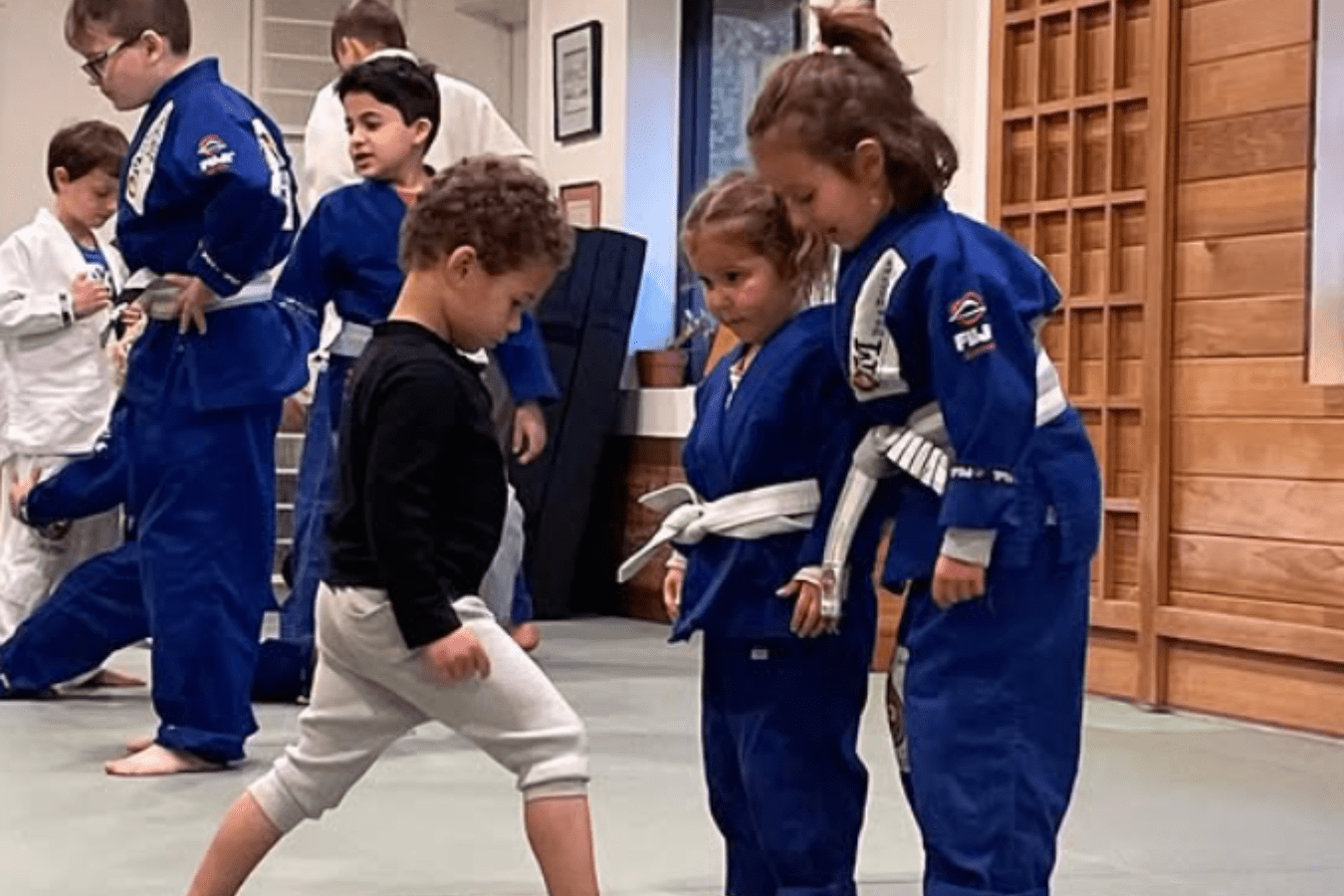
The right kind of structure does not just keep kids busy after school, it quietly teaches them how to run their own choices.
Parents usually know what self-discipline looks like in the real world: getting homework done without a battle, sticking with a commitment after the “new” feeling wears off, and handling frustration without melting down. The challenge is finding an activity that teaches those skills in a way kids actually accept. That is where Brazilian Jiu-Jitsu fits so well.
In our kids program here in Northport, Brazilian Jiu-Jitsu is not treated like random roughhousing with a uniform. We teach it as a long-term skill with clear expectations, consistent routines, and an earned progression. Over time, that combination becomes a training ground for self-discipline, and you can see it show up in small moments that matter, like listening the first time, taking feedback, and trying again when something feels hard.
If you are exploring Brazilian Jiu-Jitsu in Northport because you want your child to build focus and follow-through, we can help you understand what actually develops those traits on the mat, and how it transfers into school, sports, and home life.
Why Brazilian Jiu-Jitsu naturally teaches self-discipline
Self-discipline is not a speech. It is a habit. Brazilian Jiu-Jitsu rewards habits because progress only shows up when kids repeat the fundamentals, show up consistently, and learn to stay calm while solving problems.
Unlike activities where a child can coast on raw athleticism, grappling forces attention to details. A small mistake in posture or balance has an immediate consequence. That feedback loop is not harsh, but it is honest, and kids tend to respond to honest systems.
Structure beats willpower, especially for kids
Kids do not need to “want it” every day to build discipline. They need a structure that makes good choices easier. We keep classes consistent in format so your child knows what to expect: warm-up, technique, drilling, and supervised sparring that matches skill level.
That predictability reduces anxiety and decision fatigue. It also creates a natural rhythm where discipline becomes normal, not dramatic.
Clear rules create calm confidence
Brazilian Jiu-Jitsu has a culture of control: tap early, respect partners, and keep each other safe. When kids learn that control is the standard, they stop relying on impulse. They learn to pause, think, and choose the right response, even while moving fast.
That matters because self-discipline is often just emotional regulation in disguise.
The belt system builds patience in a world of instant rewards
A big reason Brazilian Jiu-Jitsu builds self-discipline is simple: it takes time. In many sports, kids may “level up” quickly with a good season. In BJJ, improvement is real, but it is gradual, and the belt system makes that gradual progress visible.
Industry averages often describe adult progression like this: roughly 2.3 years to reach white belt, another 2.3 years to blue (around 4.6 total), purple around 5.6 years after that, and brown around 9.0 years total. Kids follow their own age-appropriate ranking system, but the lesson is the same: meaningful progress is earned through consistency.
That timeline is not meant to intimidate you. It is meant to create healthy expectations. Your child learns that:
- Showing up matters more than “being talented”
- Repetition is not punishment, it is how skills are built
- Long-term goals require short-term choices
Those are self-discipline skills in plain clothes.
What kids practice in class that turns into discipline at home
Discipline is not just “behaving.” It is the ability to do what needs to be done even when you feel tired, distracted, or unsure. Our training builds that ability through specific, repeatable habits.
Here are a few ways it shows up during a typical week:
• Routine and readiness: Kids line up, listen, and start together, which trains punctuality and attention without needing a lecture.
• Step-by-step learning: Techniques are taught in parts, so kids practice staying with a process rather than rushing for the finish.
• Resetting after mistakes: We normalize getting it wrong, adjusting, and trying again, which is a powerful discipline skill.
• Partner responsibility: Your child learns to be a safe training partner, which builds accountability and empathy.
• Controlled intensity: When sparring is introduced, we emphasize calm problem-solving over “winning,” and kids learn to manage impulses.
None of this is abstract. It is physical, immediate, and surprisingly memorable for kids.
The role of drilling: repetition that builds follow-through
If you have ever watched a class, drilling might look simple: the same movement repeated, again and again, with small corrections. But drilling is where discipline is forged.
Repetition does a few things for kids:
- It teaches delayed gratification, because mastery is earned over time
- It builds focus, because details matter
- It builds confidence, because improvement becomes predictable
In Brazilian Jiu-Jitsu, a child can feel clumsy one day and sharper the next, simply because they stuck with the reps. That experience builds trust in effort, which is one of the healthiest foundations for self-discipline.
Hybrid training: why adding judo and wrestling-style movement helps kids
Modern grappling is evolving. More programs are blending takedowns, clinch work, and positional control, pulling from wrestling and judo as well as Brazilian Jiu-Jitsu. We embrace that trend because it makes kids more adaptable and, honestly, more engaged.
Adaptability is a discipline skill. When kids learn multiple ways to solve the same problem, they stop freezing when Plan A fails. They learn to adjust, stay composed, and keep working.
You will see this in drills that include:
- Balance and off-balancing games
- Safe falling skills that reduce fear and hesitation
- Takedown entries that teach timing and coordination
- Transitions between standing and ground positions
The result is not just better grappling. It is a child who is more comfortable learning new things without quitting.
Goal-setting kids can understand (and actually stick with)
Self-discipline grows when kids can see what they are working toward. We use simple, concrete goals that keep motivation steady, even when progress feels slow.
A helpful way to think about goal-setting in our kids program is a three-step ladder:
1. Attendance goals: Show up consistently and build the habit first.
2. Skill goals: Improve one position or one escape over a few weeks.
3. Character goals: Demonstrate respect, coachability, and self-control during live rounds.
When kids hit these goals, the win is bigger than a new technique. It is proof that they can commit to a process.
Safety and self-discipline go together, not against each other
A lot of parents ask about safety, and that is a smart question. Grappling does include risk, like any sport, but structured training reduces that risk dramatically. Research and practitioner surveys have shown injuries can increase with experience level and intensity, which is one reason kids classes need clear supervision and progressive training.
We treat safety as part of discipline. Kids learn boundaries, tapping, controlled movement, and how to be responsible with training partners. When those habits become automatic, kids become safer, more confident, and more coachable.
How we keep kids training smart
We keep safety practical and consistent, including:
- Age-appropriate grouping and skill matching
- Clear rules for contact, pace, and resets
- Progressive introduction of sparring
- Emphasis on technique over strength
- Ongoing reminders that control matters more than ego
For many kids, this becomes one of the first places where “discipline” feels empowering instead of restrictive.
How Brazilian Jiu-Jitsu supports school performance and emotional control
Self-discipline is often easiest to notice outside the academy. Parents tell us they start seeing changes like better frustration tolerance, improved listening, and a calmer response to setbacks.
That makes sense, because Brazilian Jiu-Jitsu is basically problem-solving under pressure. A child gets pinned, feels stuck, then learns a sequence to escape. That is emotional regulation plus decision-making, practiced in a safe environment.
Over time, kids learn to:
- Pause instead of panic
- Breathe and think through stress
- Accept feedback without taking it personally
- Stick with a task that is not instantly fun
Those skills line up with what teachers call “executive function,” but kids just experience it as, “I can handle this.”
A note for parents training too: family consistency matters
Even though this article focuses on kids, many parents are curious about adult Brazilian Jiu-Jitsu in Northport as well. When families train, discipline becomes a shared language. Your child sees you show up, learn, struggle a bit, and keep going. That example is powerful, and it tends to make kids more consistent.
If your schedule allows it, pairing a kids class with an adult class can turn training into a steady weekly rhythm, not another chaotic activity you have to force.
Take the Next Step
If your goal is a child who listens better, follows through more often, and handles challenge without shutting down, Brazilian Jiu-Jitsu gives you a practical path to get there. We build discipline through consistent routines, clear expectations, and a progression that rewards effort over time, and that approach fits busy Northport families who want something real, not just another short-lived activity.
When you are ready, we will help you choose a starting point that matches your child’s age and personality, and we will make sure you understand the class schedule, what to bring, and how our coaching keeps training safe and structured at OM Brazilian Jiu JItsu & Judo.
No experience is needed to begin. Join a Brazilian Jiu-Jitsu class at OM Brazilian Jiu Jitsu & Judo today.